

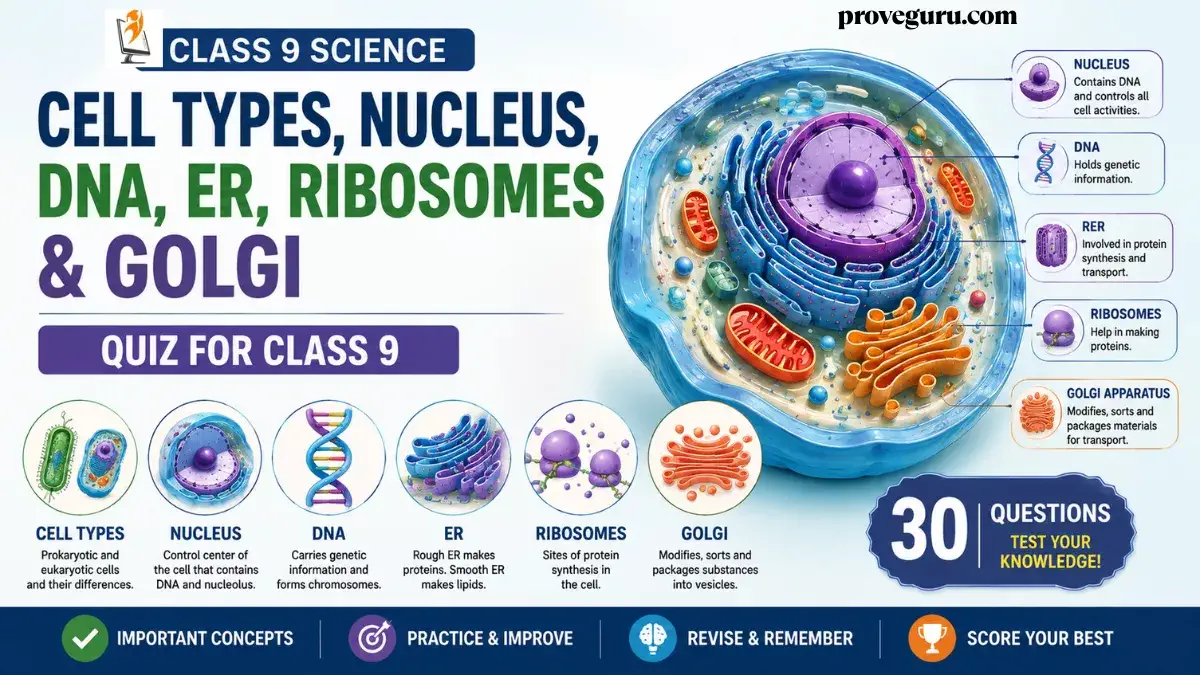
Cells have many parts that work together to keep them alive and active. Different types of cells have different structures and features. This 30-question Class 9 Science quiz will help you revise these cell structures and understand their functions.
Prokaryotic cells do not have a well-defined nucleus or membrane-bound organelles. Eukaryotic cells have a well-defined nucleus and several membrane-bound organelles.
The nucleus contains DNA, which carries important information for the structure and activities of the cell. Other cell parts, such as ribosomes, the endoplasmic reticulum (ER), and the Golgi apparatus, also perform important jobs.
Quiz Time:
What This Quiz Covers
- Prokaryotic and eukaryotic cells
- Differences between prokaryotic and eukaryotic cells
- Nucleoid in prokaryotic cells
- Structure and function of the nucleus
- Nuclear membrane and nucleolus
- DNA, chromosomes, genes, and chromatin
- Role of DNA in cells
- Red blood cells and their lack of a nucleus
- Ribosomes and protein synthesis
- Endoplasmic reticulum (ER)
- Rough endoplasmic reticulum (RER)
- Smooth endoplasmic reticulum (SER)
- Functions of RER and SER
- Golgi apparatus
- Modification, sorting, and packaging of substances
- Formation of vesicles
- Role of cell organelles in cell activities
Why Take This Quiz?
This quiz can help Class 9 students:
- Revise important cell structures
- Understand prokaryotic and eukaryotic cells
- Learn the role of the nucleus and DNA
- Understand chromosomes and genes
- Review the functions of ribosomes
- Learn the difference between RER and SER
- Understand the role of the Golgi apparatus
- Practise multiple-choice questions
- Prepare for school tests and exams
- Find topics that need more revision
Read each question carefully and choose the answer that best fits the question.
Key Points
- Prokaryotic cells: Do not have a well-defined nucleus or membrane-bound organelles.
- Eukaryotic cells: Have a well-defined nucleus and membrane-bound organelles.
- Nucleoid: The region where the genetic material lies in a prokaryotic cell.
- Nucleus: Controls many cell activities and contains genetic material.
- DNA: Carries important information that controls the structure and activities of cells.
- Chromosomes: Contain DNA and become clearly visible during cell division.
- Genes: Functional segments of DNA.
- Ribosomes: Help make proteins.
- Rough ER: Has ribosomes and helps make and transport proteins.
- Smooth ER: Does not have ribosomes and helps make and store fats and hormones.
- Golgi apparatus: Modifies, sorts, and packages substances into vesicles.
- Vesicles: Small structures that help transport packaged materials within or outside the cell.
- Red blood cells: Mature human red blood cells do not have a nucleus, which provides more space for haemoglobin.
Explore More Cell Quizzes
Finished this quiz? Continue your Class 9 Cell: The Building Block of Life revision with the other quizzes:
- Cell Basics, Origin of Life, Cell Theory & Microscopes Quiz
- Cell Membrane, Diffusion, Osmosis & Cell Wall Quiz
- Lysosomes, Mitochondria, Plastids, Vacuoles & Organelles Quiz
- Cell Growth, Division, Mitosis, Meiosis, Cancer & Applications Quiz
Take these quizzes one by one to revise the chapter and build a stronger understanding of cell structure and function.
