

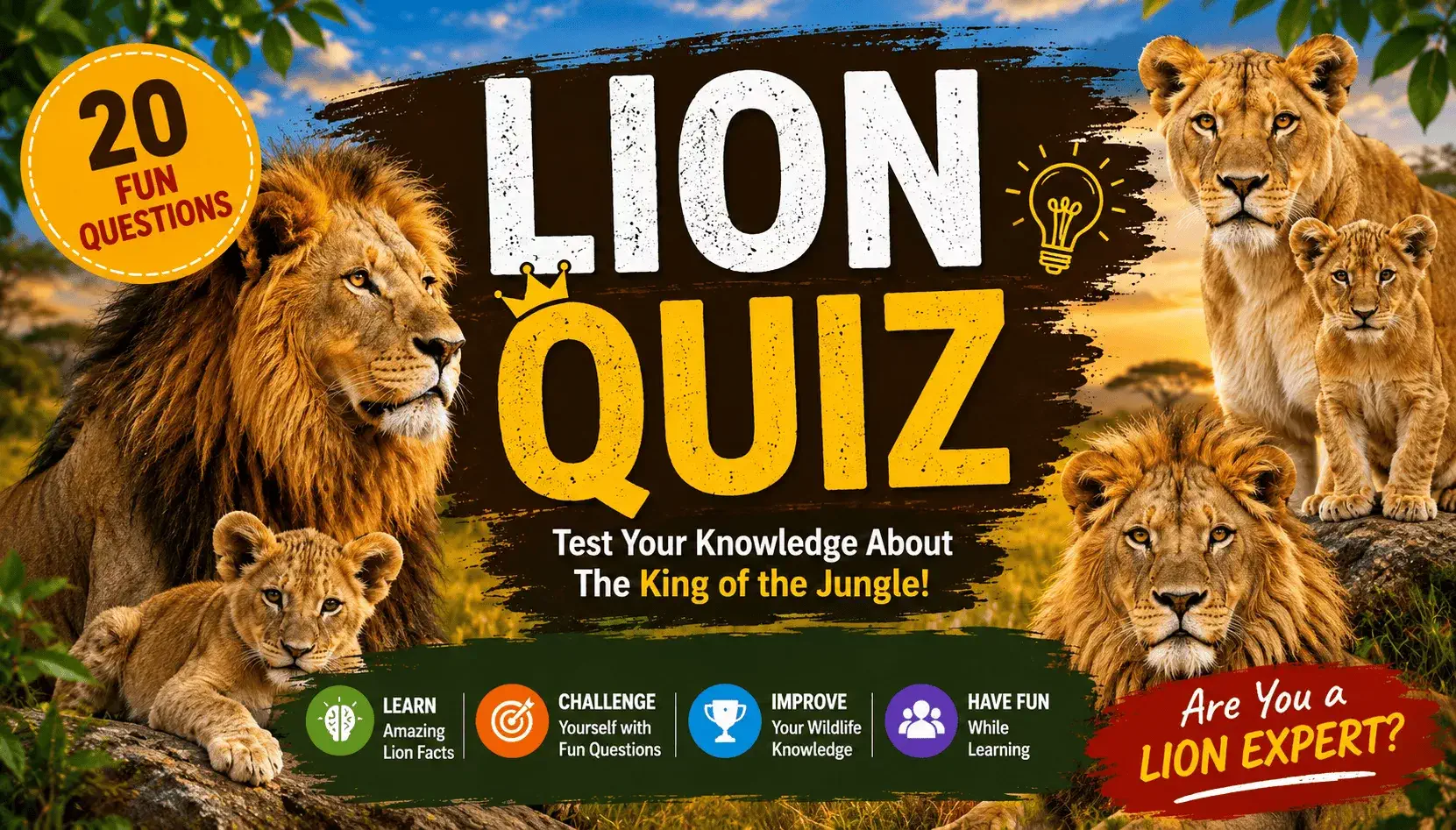
The lion (Panthera leo) is one of the world’s most famous wild animals and is often called the King of the Jungle, even though lions mainly live in grasslands and savannas rather than jungles. Known for their strength, courage, and majestic appearance, lions have fascinated people for thousands of years. They appear in stories, movies, national symbols, and cultural traditions across the world. This lion quiz will help you learn more about lion families.
Lions are the second-largest members of the cat family after tigers. Male lions are easy to recognize because of their impressive manes, which can range from light blonde to dark brown or black. The mane helps protect the neck during fights and also makes males appear larger and more intimidating.
Unlike most big cats, lions are highly social animals. They live together in groups called prides, which usually consist of several related females, their cubs, and a few adult males. Female lions do most of the hunting while males protect the pride’s territory from rival lions and other predators.
Lions are powerful carnivores that feed mainly on large mammals such as zebras, wildebeests, buffaloes, and antelopes. Working together allows female lions to hunt animals much larger than themselves. After a successful hunt, the pride shares the meal, although dominant males often eat first.
These magnificent animals once roamed across much of Africa, Europe, and Asia. Today, wild lions are mostly found in sub-Saharan Africa, with a small population of Asiatic lions surviving in India’s Gir Forest. Conservation efforts have helped protect these rare lions, but habitat loss and human conflict continue to threaten lion populations worldwide.
Lions communicate using roars, growls, grunts, and body language. A lion’s roar is incredibly powerful and can be heard from up to 8 kilometers (5 miles) away, helping members of the pride stay connected and warning rivals to stay away.
Lion cubs are born with spotted coats that gradually fade as they grow older. Cubs learn important survival skills by observing and playing with adult lions. Female lions often help care for each other’s young, making pride life an excellent example of teamwork in nature.
Although lions spend much of their time resting—sometimes up to 20 hours a day—they become highly active during cooler evening and nighttime hours. Their excellent night vision makes them effective hunters after sunset.
Learning about lions helps us understand the importance of wildlife conservation and healthy ecosystems. As apex predators, lions help control herbivore populations, maintaining balance in their habitats. Protecting lions also protects many other species that share the same environment.
If you enjoy wildlife, challenge yourself with the lion quiz below. Discover fascinating facts about lion behavior, habitat, diet, and conservation while testing how much you really know about one of nature’s most iconic animals.
10 Interesting Lion Facts
- Lions are the second-largest wild cats after tigers.
- Male lions grow impressive manes that protect their necks.
- Lions live in family groups called prides.
- Female lions perform most of the hunting.
- A lion’s roar can be heard up to 8 km away.
- Lions can run up to about 80 km/h for short distances.
- They spend around 16–20 hours resting every day.
- Asiatic lions survive only in India’s Gir Forest.
- Lion cubs are born with faint spots that fade with age.
- Lions are apex predators that help maintain ecosystem balance.

5 FAQs
1. Why is the lion called the King of the Jungle?
Because of its strength, leadership, and majestic appearance, even though lions mostly live in grasslands rather than jungles.
2. Where do lions live?
Most lions live in sub-Saharan Africa. Asiatic lions are found only in Gir National Park, India.
3. What do lions eat?
Lions are carnivores that eat zebras, wildebeests, buffaloes, antelopes, and other large mammals.
4. How long do lions live?
Wild lions usually live around 10–14 years, while lions in captivity may live over 20 years.
5. Are lions endangered?
Lions are listed as Vulnerable, and some populations are endangered due to habitat loss, poaching, and human-wildlife conflict.
Continue Learning
If you enjoyed this quiz, explore more educational quizzes on ProVeguru:
New quizzes are added regularly to help you learn while having fun.

5 Comments
Pingback: Elephant Quiz: 20 Fun Questions with Amazing Elephant Facts
Pingback: Giraffe Quiz: 20 Fun Questions, Amazing Facts & Answers
Pingback: Zebra Quiz – 20 Fun Questions with Amazing Zebra Facts
Pingback: Panda Quiz – 20 Fun Questions with Amazing Panda Facts
Pingback: Kangaroo Quiz – 25 Fun Questions with Answers