

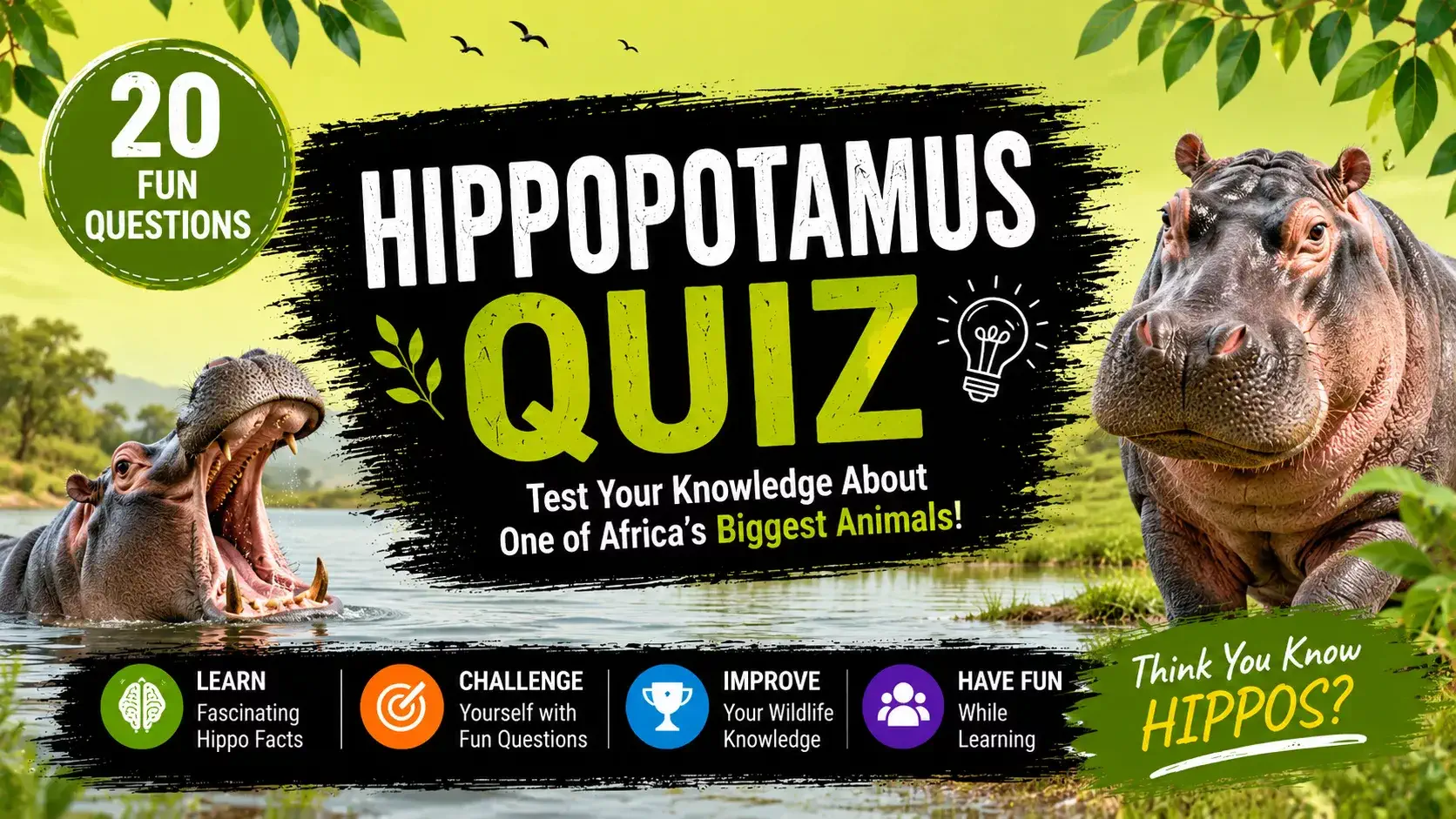
Welcome to our Hippopotamus Quiz! Wanna take this animal quiz to check out how much you know about one of Africa’s most interesting animals? This quiz contains 20 fun multiple choice questions about the Hippopotamuses. Students, teachers, parents or wildlife enthusiasts will find interesting facts, and they will have fun along the way!
One of the largest land mammals on earth is called the hippopotamus also known as the hippo. It is found in rivers, lakes and wetlands, where it stays cool for most of the day. It comes out of the water at nighttime to feed on grass. Hippos appear placid and slow, but they can run quite quickly on land and are very strong fighters.
Hippos have special characteristics that enable them to endure. They have their eyes, ears and noses on top of their heads so they can be virtually submerged in water without any problem to see, hear, and breathe. They also excrete a special reddish secretion from its skin that protects it from the sun and harmful bacteria.
Hippos are of great value for the maintenance of healthy freshwater ecosystems. They travel from land to water and back again each day, which assists in the nutrient recycling and supplies lots of other organisms. Unfortunately, habitat loss and poaching pose a threat to wild hippos, and conservation is more critical than ever.
This Hippopotamus Quiz will help you learn about the habitat, food and lifestyle of the Hippopotamus, its physical characteristics and some amazing adaptations. Each question teaches you something new about these amazing creatures! Share the quiz, quiz your friends, and see how many you can get right!
Quiz Time

Why are Hippopotamuses so special?
Hippopotamuses are special in that they are huge and have some amazing adaptations. They live a lot of their lives in the water, but come on land every evening to feed. Their eyes, ears and nostrils are all located on top of their heads so they can keep the majority of their body submerged in the water but still be alert.
Hippos are also the heaviest land animals in the world! In spite of their size, they can outrun many people at short distances. They have strong jaws and large canines to defend themselves. A special characteristic is their red skin secretions, which are sometimes referred to as “blood sweat. It’s not blood or sweat. Rather, it helps maintain the moisture of their skin and protects it from harmful UV rays and bacteria.
Additionally, Hippos have a role in promoting healthy ecosystems through their transfer of nutrients and nutrients between the land and water. Saving them is a way of saving many other flora and fauna that live alongside them.
Interesting Facts About Hippopotamuses
- Hippopotamuses are the third largest terrestrial mammal species, after the elephant and white rhino.
- The word hippopotamus means river horse and it is from Greek.
- Hippos can be found in water for up to 16 hours per day.
- They can hold their breath underwater for about five minutes.
- The adult hippos can weigh over 3,000 kilograms.
- Hippos eat principally grass and typically feed in the evening.
- Hippos can open their mouths up to almost 150 degrees.
- Baby hippos can suckle on water.
- Hippos grunt, bellow and make other loud noises.
- The wild hippo is found primarily in rivers, lakes and wetlands of sub-Saharan Africa.
Did You Know?
- Hippos can sleep under water and come to the surface to breathe without waking up.
- Most of the time, Hippos will get out of the water at night to look for food.
- Baby hippos can swim nearly right out of the hatch.
- Hippos will feed on short grasses and are herbivores.
- They require much water to keep their skin moist, and dry out rapidly.
- Although hippos are massive animals, they can be more agile than most humans, running faster than most.
- They have canine teeth that can reach a length of over 50 cm.
- The majority of wild hippopotamuses roam in sub-Saharan Africa.
Frequently Asked Questions (FAQ)
1. What do you think a hippopotamus is?
The hippopotamus is a large herbivorous mammal found in sub-Saharan Africa, near rivers, lakes, and wetlands.
2. What do hippos eat?
Hippos primarily feed on grasses. At night they go out of the water to graze.
3. In what parts of the world does the hippo live?
They are found in sub-Saharan Africa in freshwater environments including rivers, lakes, swamps and wetlands.
4. Can you predict how far the hippo will swim?
Unlike other animals, hippos typically walk, push off the bottom of the river or swim underwater.
5. How long can a hippopotamus stay underwater?
The hippopotamus can hold its breath for about 5 minutes for every minute it is underwater.
6. How do hippos keep from drowning?
Water helps them regulate their temperature, keeps their skin hydrated and helps keep them protected from the heat of the African sun.
7. Are hippopotamuses dangerous?
Yes. Hippos are strongly built wild animals and can be aggressive when threatened or to defend their young.
8. What is the maximum speed at which a Hippopotamus can run?
A hippopotamus can run at a maximum speed of 30 km/h (19 mph) for short distances.
9. Which of the following endangers the hippopotamuses the most?
The most serious threats to the wild population of hippos are habitat loss, illegal hunting, and conflict with humans.
10. What is the reason for protecting hippopotamuses?
Hippos are a valuable contributor to good fresh water health. If they are protected, they will be protected by many other plants and animals sharing their habitats.
Continue Learning with More Fun Quizzes
If you enjoyed this Panda Quiz, explore more exciting educational quizzes:
